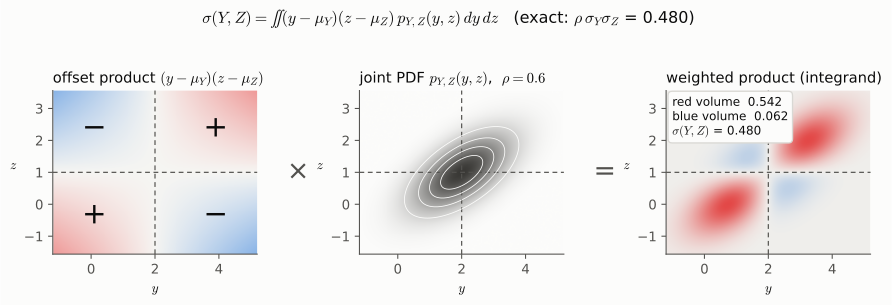
Every point (y,z) of the plane contributes the product of its offsets from the means, (y−μY)(z−μZ). The product is positive in the upper-right and lower-left quadrant around (μY,μZ) and negative in the other two (left). The joint PDF weights each contribution by how much probability lies near that point (middle). The covariance is the volume under the weighted product (right): red volume minus blue volume. A joint PDF stretched along the rising diagonal puts most of its mass into the + quadrants, so σ(Y,Z)>0. Along the falling diagonal, σ(Y,Z)<0.
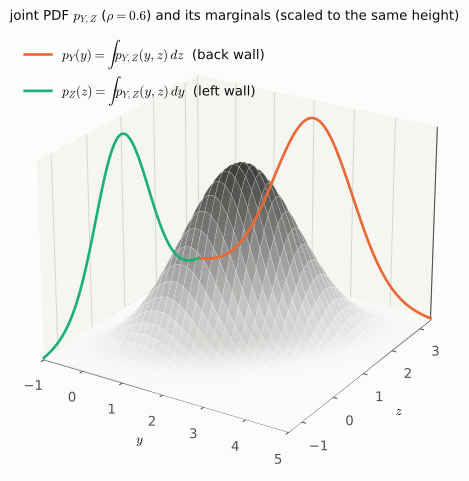
Looking at the joint PDF from the side gives the PDF of one variable, the marginalpY(y)=∫pY,Z(y,z)dz. “From the side” means adding up everything along the line of sight, like an X-ray, not the outline of the surface. For a normal distribution both have the same shape; in general they don’t. The marginals don’t determine the covariance: tilting the surface (changing ρ) leaves both marginals unchanged. The covariance lives in the joint PDF only.
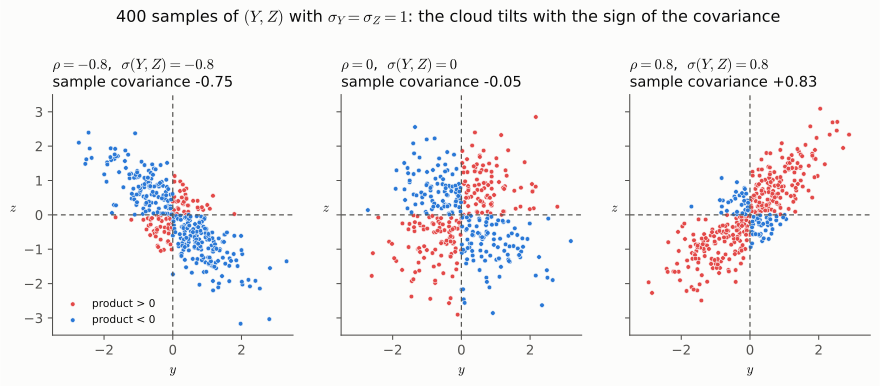
N=400 samples of (Y,Z) from a bivariate normal distribution with σY=σZ=1, so σ(Y,Z)=ρ (Correlation). Red points have a positive offset product, blue ones a negative. The sample covariance N1∑k=1N(yk−yˉ)(zk−zˉ), with sample means yˉ, zˉ, is the same weighting with the PDF replaced by the points: a rising cloud has mostly red points, a falling one mostly blue, and a round cloud about as many of each.
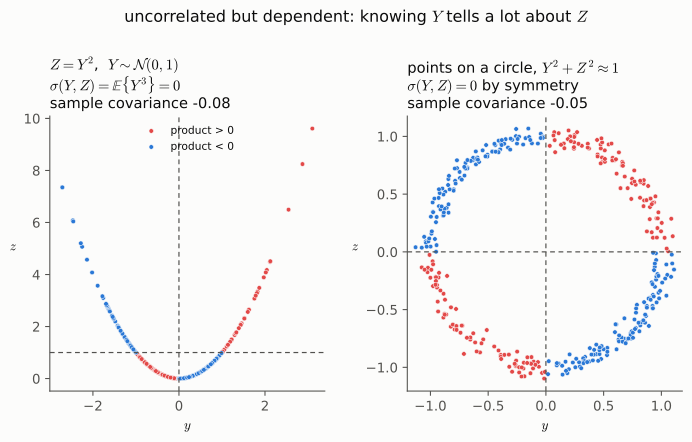
Zero covariance does not mean independence. Left: Z=Y2 with Y∼N(0,1), so Z is fully determined by Y. But every point (y,y2) has an equally likely mirror point (−y,y2) with the opposite product, so the quadrants cancel: σ(Y,Z)=E{Y⋅Y2}−μYμZ=E{Y3}−0=0. Right: points on a circle, σ(Y,Z)=0 by symmetry. Covariance only measures how much the joint PDF leans along a straight line.