The determinant det(A) of a square matrix A is the number that gives the signed volume of the parallelepiped spanned by its columns, i.e. the factor by which A scales volumes; det(A) ≠ 0 iff A is invertible.
See Invertible Matrix > Properties for the other equivalent conditions. Geometrically, det(A)=0 means the columns are linearly dependent, so they span a flat parallelepiped with volume 0.
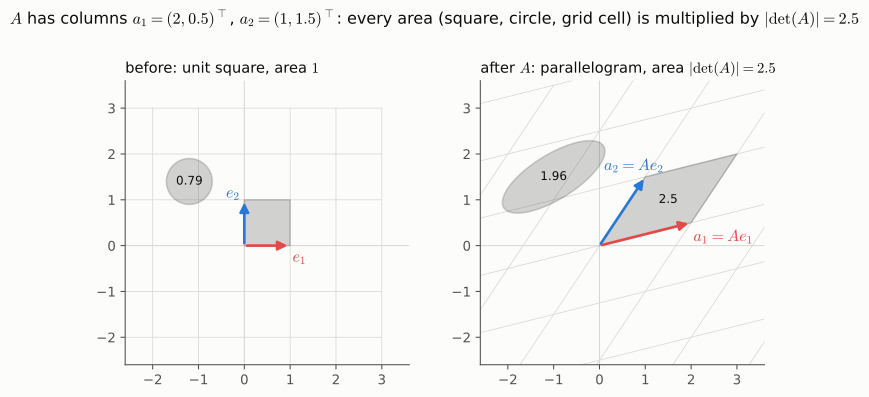
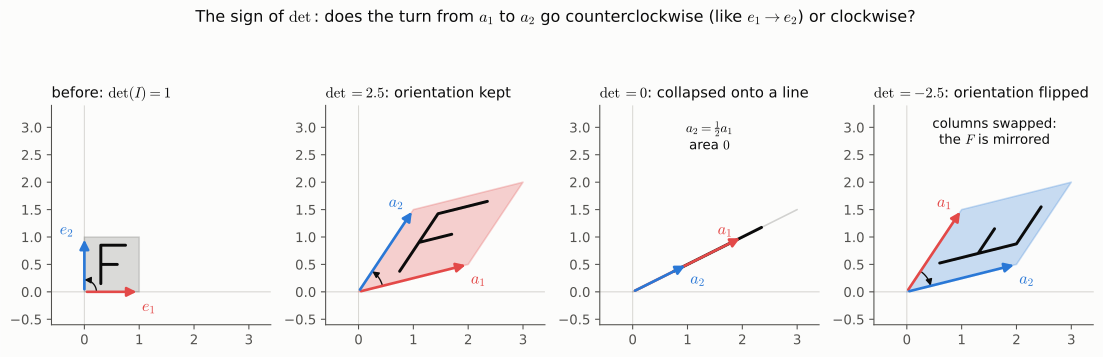
Signed volume (MML Example 4.2): ∣det(A)∣ is the volume of the parallelepiped spanned by the columns a1,…,an of A, and for n=2 the area of the parallelogram with vertices 0,a1,a2,a1+a2. The sign gives the orientation of (a1,…,an) relative to the standard basis (e1,…,en). Swapping two columns flips it.
Rules for A,B∈Rn×n (MML p. 103):
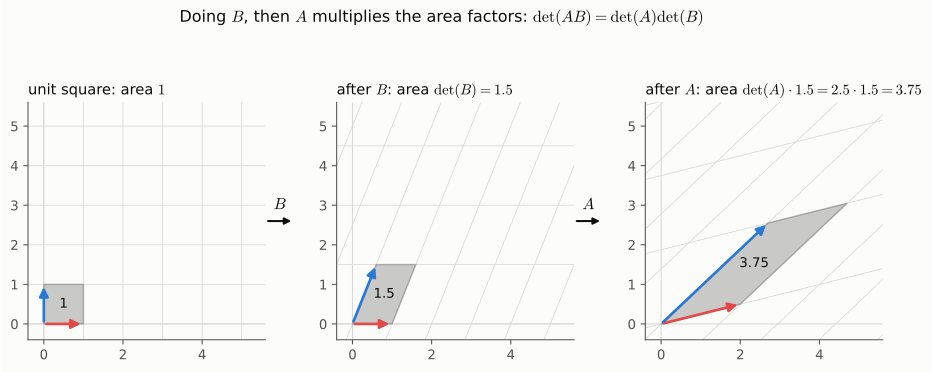
det(AB)=det(A)det(B).
det(A⊤)=det(A). So every statement about columns holds for rows as well.
det(A−1)=det(A)1 if A is invertible (from det(A)det(A−1)=det(I)=1).
Similar matricesB=S−1AS have the same determinant. So det is a property of the linear map, independent of the basis.
Adding a multiple of one row/column to another doesn’t change det(A).
Multiplying one row/column by λ∈R multiplies det(A) by λ. In particular det(λA)=λndet(A).
Swapping two rows/columns changes the sign of det(A).
det(A)=∏i=1nλi, the product of the eigenvalues counted with algebraic multiplicity (MML Thm. 4.16).
Computing it: the last three row rules say how each step of Gaussian elimination changes det. Reduce A to triangular form, multiply the diagonal entries, and correct the sign once per row swap. This costs O(n3) operations.
A matrix A sends e1 to its first column a1 and e2 to its second column a2, so the unit square becomes the parallelogram spanned by a1,a2. Its area ∣det(A)∣ is the factor by which A scales every area: the image of the grid consists of equal parallelograms, each ∣det(A)∣ times as large as a grid cell, and any shape can be filled with ever finer grid cells. So the disk of area 0.79 becomes an ellipse of area 2.5⋅0.79=1.96. So det is not a property of the square but of the map.
The sign tells whether A keeps or flips orientation. Turning from e1 to e2 goes counterclockwise. If the turn from a1 to a2 does too, det(A)>0 and the letter F stays readable. If the turn is clockwise (here: the columns swapped), det(A)<0 and the F comes out mirrored. In between lies det(A)=0: the columns are parallel (a2=21a1), the whole plane is squashed onto a line, and that information can’t be undone. This is why det(A)=0 means not invertible.
Applying B scales areas by det(B), and applying A afterwards scales the result by det(A). Together the area changes by det(A)det(B), which gives det(AB)=det(A)det(B) without any computation. The same picture gives det(A−1)=1/det(A), because A−1 must undo the scaling.
MML pp. 99–100 (motivation, 2×2 case, Thm. 4.1), MML p. 101 (triangular matrices, Example 4.2: signed volume), MML pp. 102–103 (Laplace expansion Thm. 4.2, Example 4.3, rules, Thm. 4.3)
MML p. 104 (characteristic polynomial, c0=det(A)), MML p. 112 (Thm. 4.16: det = product of eigenvalues)