A number λ is an eigenvalue of a square matrix A if Ax = λx for some vector x ≠ 0, i.e. if A only scales some direction by λ; the eigenvalues are the roots of the characteristic polynomial det(A − λI).
MML defines eigenvalues as real numbers but uses complex ones from Thm. 4.16 on. The same definition with λ∈C, x∈Cn∖{0} gives the complex eigenvalues. A real matrix can have them (see Intuition).
where tr(A)=∑i=1naii is the trace, the sum of the diagonal entries.
The algebraic multiplicity of an eigenvalue λi is how often λi appears as a root of pA (MML Def. 4.9). The geometric multiplicity is dimEλi, the number of linearly independent eigenvectors (Eigenvector > Properties). Always 1≤ geometric ≤ algebraic.
pA has degree n, so A has at most n distinct eigenvalues, and exactly n complex ones counted with algebraic multiplicity.
Computing eigenvalues as roots of pA only works by hand for small n. For n≥5 there is no general closed formula for the roots, and numerical software uses iterative methods instead.
Over C the polynomial factors as pA(λ)=(−1)n∏i=1n(λ−λi)=∏i=1n(λi−λ). Setting λ=0: det(A)=pA(0)=∏iλi. The coefficient of λn−1 in ∏i(λi−λ) is (−1)n−1∑iλi. Comparing it with cn−1=(−1)n−1tr(A) gives tr(A)=∑iλi.
Singular ⇔ eigenvalue 0:det(A)=∏iλi=0 iff some λi=0. So A is invertible iff 0 is not an eigenvalue, and then A−1 has the eigenvalues 1/λi (from Ax=λx⇒x=λA−1x).
Basis-independent:A and A⊤ have the same eigenvalues, and so do similar matrices S−1AS (same pA). So the eigenvalues, like det and tr, belong to the linear map, not to its matrix (MML p. 106).
Triangular matrices (beyond the lecture): pT(λ)=∏i(Tii−λ), so the eigenvalues are the diagonal entries.
Symmetric matrices have only real eigenvalues (spectral theorem, Eigenvector > Properties). A symmetric matrix is positive semidefinite iff all its eigenvalues are ≥0, and positive definite iff all are >0.
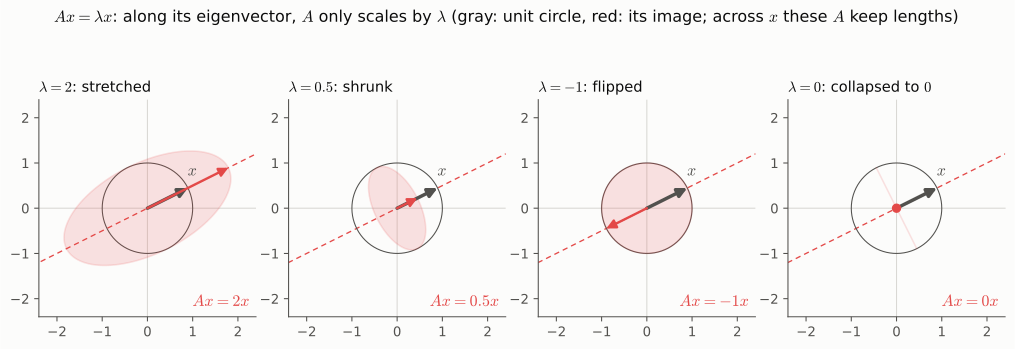
On the line through an eigenvectorx, the matrix acts like a single number: Ax=λx. The eigenvalue says what happens on that line: ∣λ∣>1 stretches it, ∣λ∣<1 shrinks it, λ<0 flips it to the other side of the origin, and λ=0 squashes it to 0, so x∈ker(A). The four matrices here keep lengths across x, so the image of the unit circle (red) shows only the effect of λ.
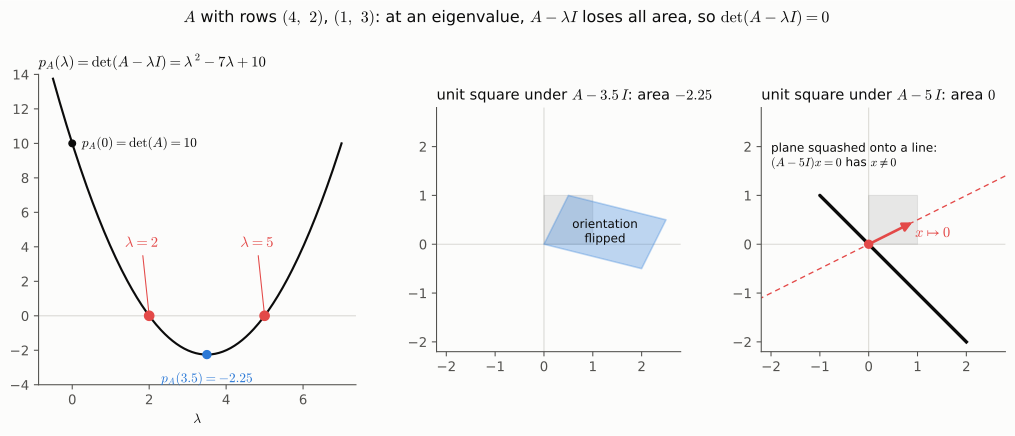
Why the eigenvalues are roots of det(A−λI): A−λI maps x to Ax−λx, and its determinant is the area of the image of the unit square. For a λ that is not an eigenvalue (λ=3.5) the square becomes a real parallelogram (signed area pA(3.5)=−2.25). At λ=5 the eigenvector x satisfies (A−5I)x=Ax−5x=0. So a whole direction is sent to 0, the plane collapses onto a line, and the area pA(5) is 0. The curve on the left also shows pA(0)=det(A).
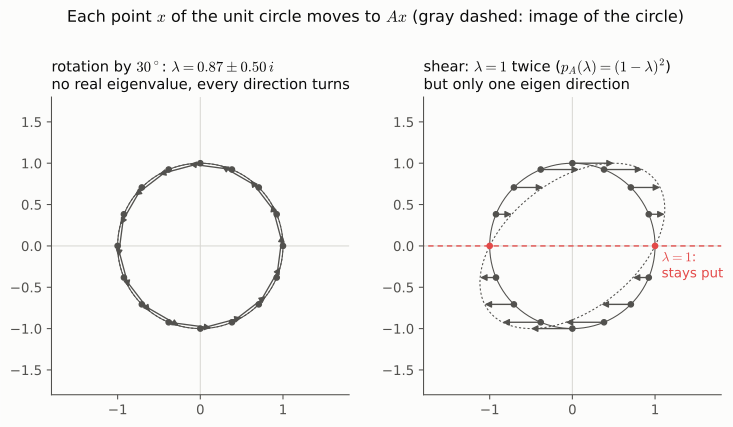
Not every matrix has real eigenvalues. Each point x on the unit circle moves to Ax, and eigen directions are those where the arrow points straight along the radius (or is 0). A rotation moves every point sideways, so no direction is kept and the eigenvalues 0.87±0.50i are complex. The shear has the double root λ=1, but only the horizontal direction stays put, so a repeated eigenvalue can come with fewer eigenvectors than its multiplicity.
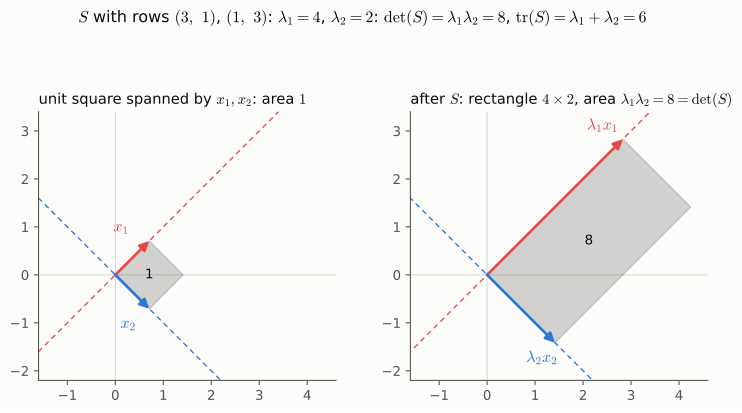
For a symmetric S with orthonormal eigenvectors x1,x2, the unit square spanned by x1,x2 is mapped to the rectangle spanned by λ1x1,λ2x2. Its sides are λ1=4 and λ2=2, so its area is λ1λ2=8, and that is det(S) by the area picture of the determinant. This is det(A)=∏iλi. The trace counts the side lengths instead: λ1+λ2=6=tr(S) (MML Fig. 4.6).