Merge Join
Also Sort-Merge Join
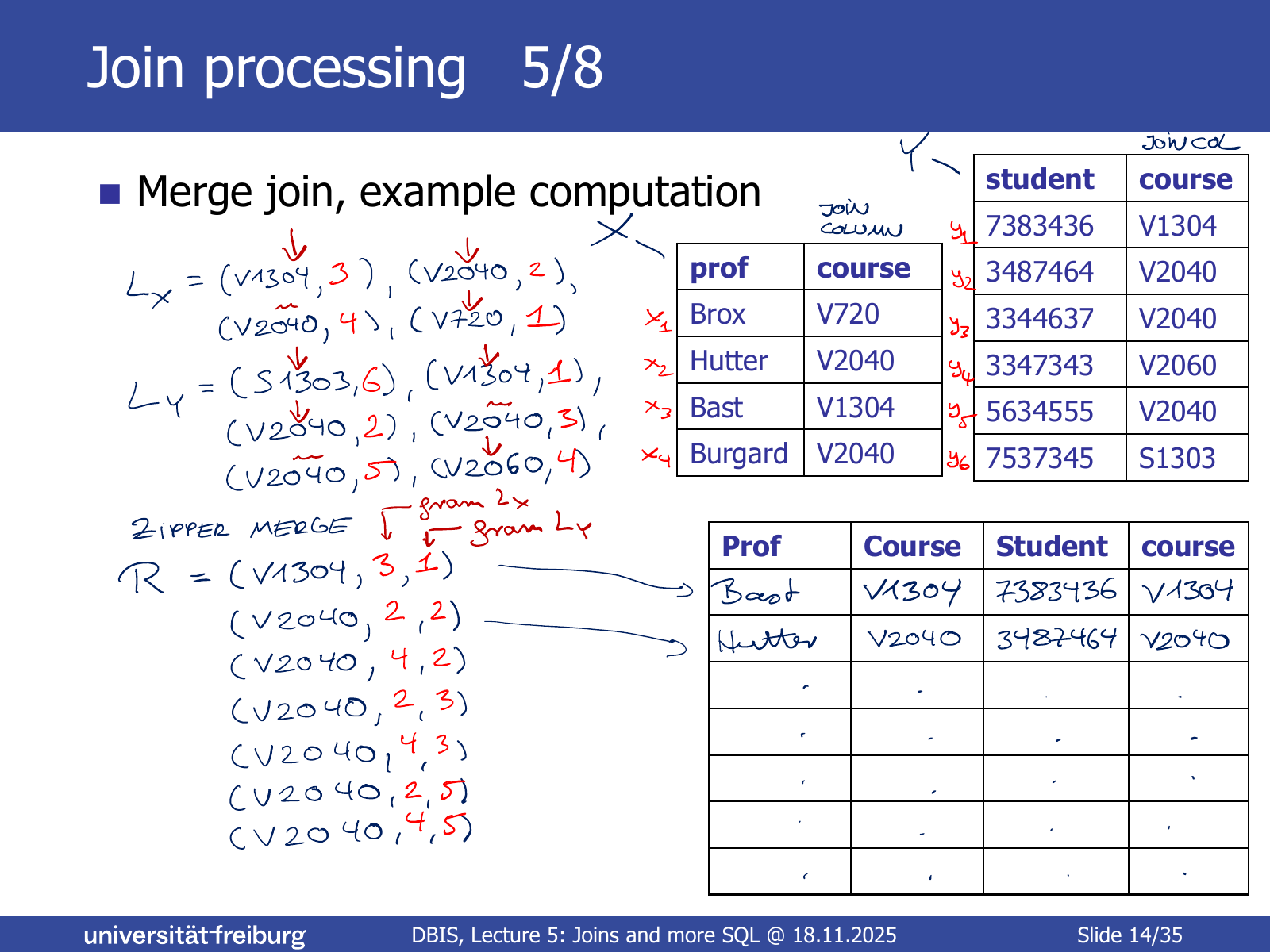
The merge join computes an equi-join from the join-column values of both tables in sorted order, as (value, row index) pairs, by a Zipper merge that outputs all combinations of rows with equal values.
Formula#
Running time, given the already sorted sequences:
where and are the numbers of rows and columns of the result, is the average cost of comparing or writing one element in the Zipper algorithm and the average cost of copying one value to the result.
Simplified estimate for query planning (same as for the hash join, constants ignored):
The row estimate assumes each row of the smaller table has exactly one match in the larger one.
Properties#
- Algorithm (two pointers in , in ): if advance ; if advance ; if , determine the runs of pairs with value in both lists, output all combinations of the two runs, and advance both pointers past their runs.
- vs. hash join: asymptotically the same as the hash join , but typically and , so the merge join is faster, especially when both and are large. It needs sorted input, which the hash join does not.
- Worst case: if all join values are equal, and the merge join is as expensive as the Cartesian Product.
- Sorted input from indexes: scanning the linked leaves of an index B+ Tree yields all (value, row index) pairs in sorted order. With a B+ tree on both join columns this is exactly the input of the merge join.
- SQLite3 performs neither merge nor hash joins: it iterates over one join column and looks up each value in an index on the other (built temporarily if none exists), even when both columns have a B+ tree (“an interesting design decision”). A typical RDBMS supports both merge and hash joins, and choosing between them is part of query planning.
Example#
Sources#
- Slides 05, p. 13 (definition), p. 14 (example), p. 15 (running time), p. 16 (cost estimate), p. 17 (SQLite3)
- Slides 06, p. 11 (B+ tree leaves as merge-join input)
- DBIS_VL05 > Merge join, DBIS_VL05 > Cost estimates for ES5, DBIS_VL05 > Particularities of SQLite3, DBIS_VL06 > Index B+ tree